
Your Board Can Check the Sources. Can It Check the Math?
Nov 25, 2026 · @Cosstech

Every big decision gets a second hearing. It comes months later, when the numbers have moved and someone asks how the board got there.
Most boards can answer half of that question. They can show where the facts came from. What they usually cannot show is how those facts turned into a yes.
That second half is where decisions get challenged, and it is the half almost nobody keeps on record.
Sources are easy. The judgment is not.
Good research comes with references. You can click through, check the data and confirm that each fact is real.
The weak point sits one step later. Somebody takes those facts and turns them into a call: this option will probably pay back within three years, that one carries too much risk. That step lives in a spreadsheet, a slide or someone's head.
Ask a board to rebuild it six months on and the answers start to drift. Would a different analyst have reached the same view from the same evidence? Usually nobody can say.

Chatbots make it worse
Many teams now ask an AI assistant to weigh the options. The answer comes back fast, well written and confident.
It also comes back with no working. Ask the same question tomorrow and the numbers may change. Ask where a figure came from and there is often no source at all, because the model wrote it.
That is fine for a first draft. It is a problem for a decision a board will have to defend.
The engine owns every number. The AI only does the words.
We built BrainPower at SmarThinkerz around one rule: a language model never invents a figure. A deterministic engine computes every number. The AI explains the result in plain language and nothing more.
That rule shapes how it behaves:
- It does not guess. If key inputs are missing, it asks for them before it runs anything.
- It will not fill gaps for you. It refuses to invent a missing year of projections, and it will not choose your cost of capital.
- It labels what you assumed. Every figure is marked as either measured or an assumption you chose to make, and that label follows it through the analysis.
- It withholds unsupported claims. If the written explanation contains a number that came neither from you nor from the engine, the explanation is withheld. The computed results stay.
The point is simple. Every number on the screen can be traced to you or to the math.
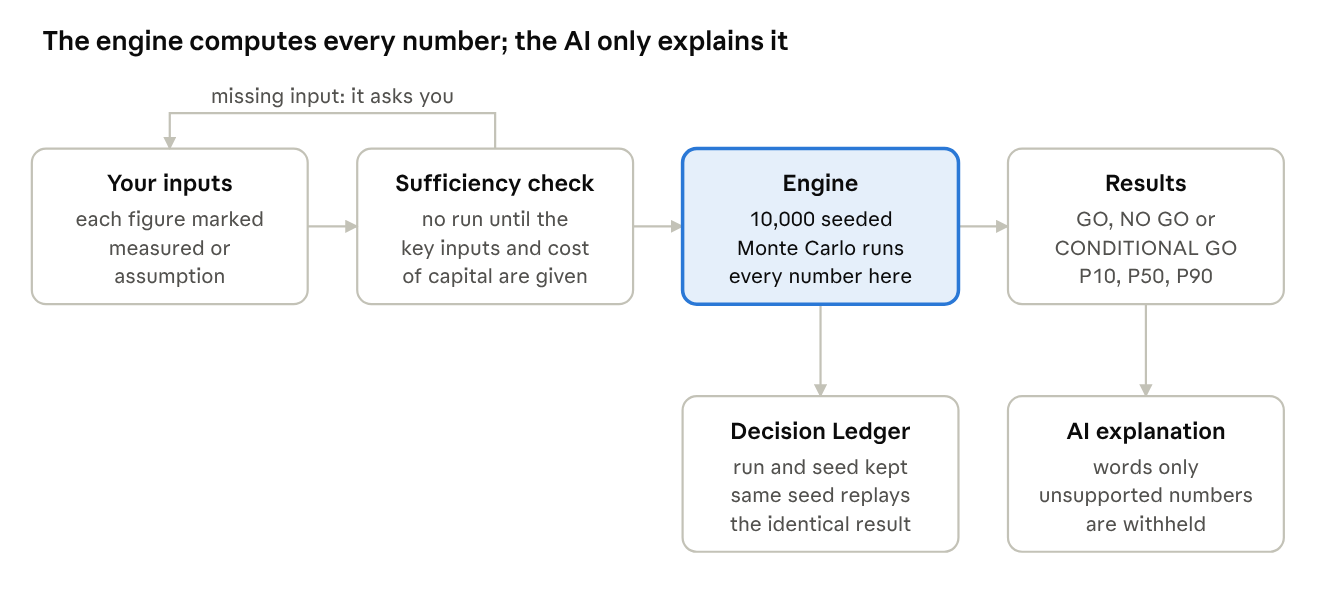
How a BrainPower analysis flows · inputs to replay
Nothing reaches the board unless it came from your inputs or from the engine's own runs.
What the board actually sees
Each analysis runs the full 10,000 Monte Carlo iterations, never fewer. The board gets:
- A verdict: GO, NO GO or CONDITIONAL GO.
- The range, not one number: the P10, P50 and P90 outcomes, so the bad case, the likely case and the good case sit side by side.
- What moves the result: the inputs that matter most, so the discussion goes where the risk is.
- A second opinion that argues back: the Advisory Board looks at the decision from several angles, including a Devil's Advocate and a Risk Analyst.
- A replay: every run uses a seed, and the same seed reproduces the identical result. Months later, anyone can check the working.
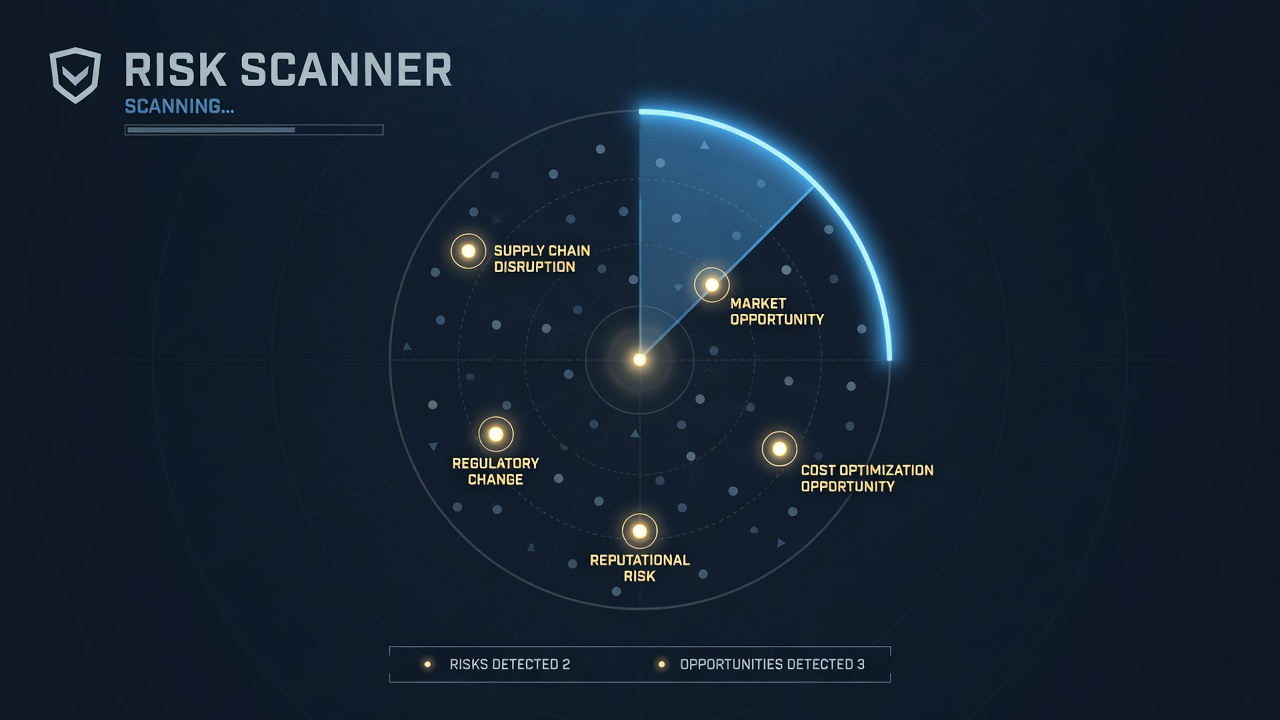
The decision and its reasoning then go into the Decision Ledger, so the organization keeps the record even when the people who made the call move on.
We have also built AMDI, our Adaptive Multi-Method Decision Intelligence engine, which combines Monte Carlo with other decision methods. We are rolling it into the live platform now.
The decision stays with people
None of this takes the decision away from the board. Judgment, values and appetite for risk still belong to the people in the room.
What changes is what they can stand behind. When the second hearing comes, they can show the facts, the assumptions and the exact working that turned them into a yes.
That is the difference between a decision that was made and a decision that can be defended.
See it at brainpoweria.com
I would be glad to walk you through it on a short online call.
Fathi Al Riyami
Founder and CEO, SmarThinkerz