
Every property listing makes the same promise. One price, one rent, one yield.
That yield is a single future. It assumes the units fill on time, the rate holds, the roof lasts and the exit price comes in where the spreadsheet said.
A property investment has thousands of possible futures. The question worth asking before you sign is how many of them you can live with.
What a single yield hides
A headline yield is built from a handful of assumptions. Each one moves, and they rarely move alone.
- Occupancy. How long units sit empty between tenants, and how long it takes to fill a new building.
- Rent. What the market pays in year three, not just today.
- Financing. What happens to the numbers if the rate resets higher.
- Running costs and repairs. The big ticket items that never appear in a listing.
- The exit. What the property sells for when you want out, and how long that takes.
Put one number on each and you get one answer. Put a realistic range on each and you get the truth: a spread of outcomes, some good, some painful.

How BrainPower analyzes a property
We built BrainPower at SmarThinkerz so the engine owns every number and the AI only explains it.
For a property, you give it the purchase price, the financing, rent and occupancy, running costs and the exit, each as a low and a high where you are unsure. You set your cost of capital; it never picks one for you. Every figure is marked as measured or as your assumption.
Then it runs the full 10,000 Monte Carlo iterations. Each run draws a different combination of rent, vacancy, rates and costs, and the results build the real spread of outcomes.
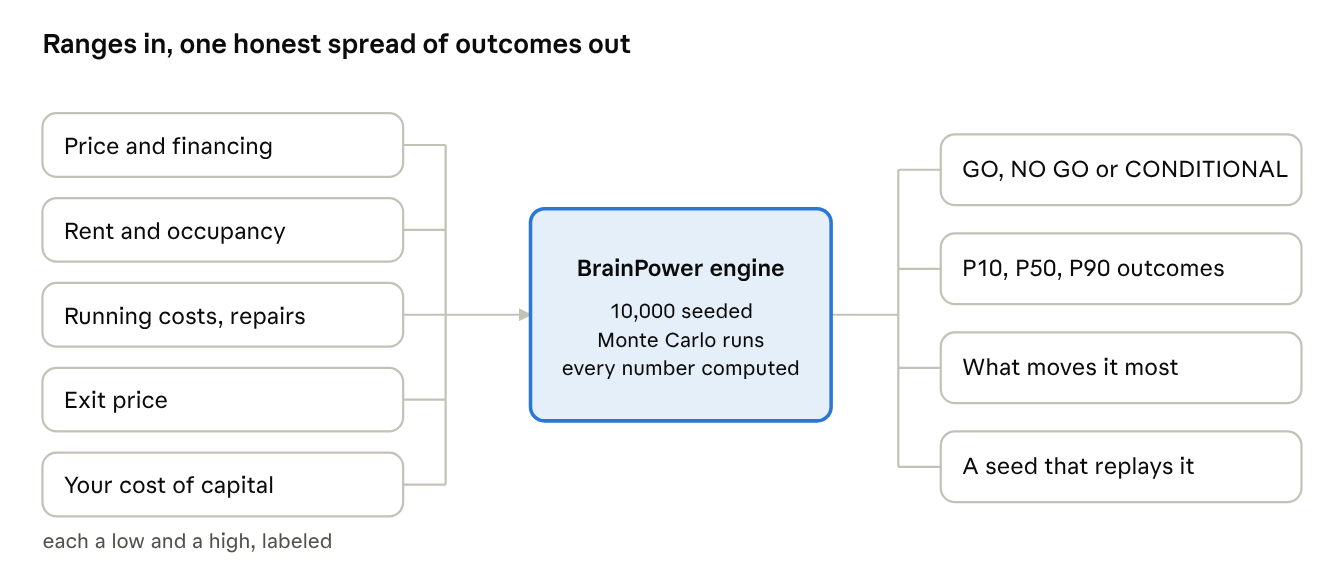
How a property investment runs through BrainPower
What the investor actually sees
- A verdict: GO, NO GO or CONDITIONAL GO.
- The range: the P10, P50 and P90 outcomes, so the bad case, the likely case and the good case sit side by side.
- What moves it: the inputs that change the result most. Often the deal turns on one or two of them, and that is where your due diligence should go.
- An argument against: the Advisory Board looks at the deal from several angles, including a Devil's Advocate and a Risk Analyst.
- A replay: every run uses a seed. A year later, the same seed reproduces the identical numbers, so you can show exactly why you bought.
Seven questions to answer before you sign
- What happens to my return if occupancy runs well below plan for the first two years?
- How long can the units sit empty before the deal stops paying for itself?
- If the financing rate resets higher, does the deal still clear my cost of capital?
- Which single repair or capital cost would hurt most, and when could it land?
- What exit price do I need, and how likely is it in the bad case?
- Which of my inputs are measured, and which are hopes?
- If I am asked in a year why I bought, can I show the exact numbers I had?
Buy the range, not the brochure
The decision stays yours. BrainPower shows you every future you are buying into, which inputs decide it, and a record you can stand behind later.
If you are weighing a property right now, I'll run it through BrainPower with you and share the full analysis.
See it at brainpoweria.com
I would be glad to walk you through it on a short online call.
Fathi Al Riyami
Founder and CEO, SmarThinkerz