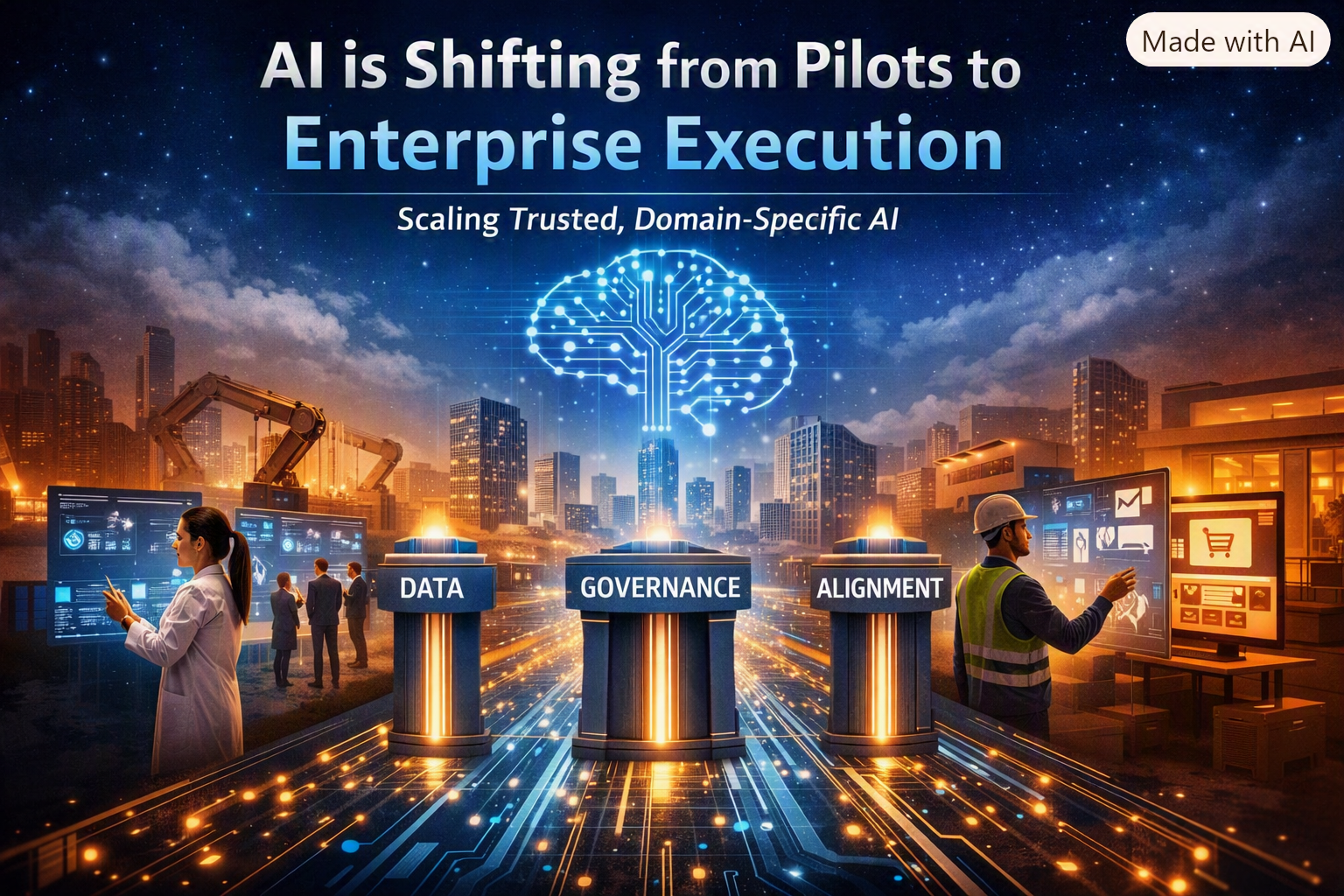
AI is no longer a side project, a flashy demo, or a lab experiment reserved for large tech firms. It has become a boardroom priority, a national agenda, and a competitive weapon. Yet many organizations still ask the same question: what comes next? After the first wave of chatbots, pilots, and proof of concepts, the next strategy of AI is not about doing more AI for the sake of it. It is about building AI that is useful, trusted, scalable, and tied directly to business outcomes.
The first era of AI strategy was driven by excitement. Companies wanted to test models, automate a few tasks, and explore what generative AI could produce. That phase was important, but it also created noise. Many initiatives lacked ownership, measurable returns, or the data foundation needed to scale. Now a new phase is emerging. The organizations that will lead are shifting from experimentation to execution. They are treating AI as a system of capabilities that must be integrated into operations, customer experience, decision-making, and growth.
From isolated tools to AI operating models
The next strategy of AI starts with a mindset shift. Instead of viewing AI as a collection of individual tools, businesses need to treat it as an operating model. That means AI must connect people, processes, data, governance, and technology. A chatbot on its own does not transform a company. An AI model embedded into sales, service, logistics, finance, and planning can.
This is where many organizations face a hard truth. Buying access to a model is easy. Building an enterprise that can use AI repeatedly and responsibly is much harder. The winners will not be those with the most tools. They will be those with the clearest architecture, the strongest internal coordination, and the discipline to align AI to strategic goals.
The AI operating model of the future will likely include a central governance layer with decentralized execution. In simple terms, leadership teams will set rules, priorities, and risk boundaries, while business units will deploy AI in real workflows. This balance matters. Too much central control slows innovation. Too little creates duplication, security gaps, and poor quality outcomes.
Organizations should ask practical questions. Who approves use cases? Who owns model performance? How is data quality maintained? What happens when a model gives a wrong answer? How are customer-facing systems monitored? These are not technical side issues. They are strategic questions that determine whether AI becomes an asset or a liability.
The rise of domain-specific AI
The next major shift in AI strategy is specialization. General-purpose models have opened the door, but domain-specific AI will create the deepest value. Businesses do not need AI that knows a little about everything. They need AI that understands their industry, their customer context, their internal language, and their operational constraints.
In healthcare, that means systems tuned for clinical workflows, patient documentation, and regulatory requirements. In retail, it means AI that understands inventory patterns, pricing sensitivity, and customer journeys. In banking, it means models designed around compliance, fraud detection, and risk scoring. In manufacturing, it means predictive intelligence connected to quality, supply chain signals, and machine maintenance.
This trend is especially important in GCC and Asian markets, where language, regulation, and business culture vary widely. The next AI strategy will not be copy and paste. It will require localization. Models must work across Arabic, English, and regional languages. They must reflect local customer behavior and regional policy expectations. Companies that build AI with local intelligence will outperform those that rely only on generic global systems.
This also changes the role of data. The most valuable competitive advantage will come from proprietary datasets, workflow signals, and real operational feedback. Public models can provide a foundation, but private data creates differentiation. That is why leading firms are investing in data pipelines, knowledge layers, retrieval systems, and structured governance around enterprise information.
AI strategy becomes business strategy
For the next phase, AI strategy cannot sit inside the IT department alone. It must become part of business strategy. That means every AI initiative should connect to one of a few outcomes: revenue growth, cost efficiency, risk reduction, customer satisfaction, speed, or innovation.
When companies fail with AI, it is often because they begin with the technology rather than the problem. They ask what the model can do instead of what the business needs done. A stronger approach is to start with friction points. Where are teams losing time? Where are customers waiting too long? Where are errors expensive? Where is knowledge trapped in documents, emails, and human memory? These are the places where AI can move from novelty to value.
A mature AI portfolio often includes use cases across three layers:
- Efficiency gains in routine work
- Decision support for managers and specialists
- New products, services, and customer experiences
The first layer delivers quick wins. The second improves quality and speed in complex work. The third creates strategic advantage. Too many organizations stay stuck in the first layer. They use AI to summarize notes or draft emails, but they do not redesign processes or rethink offerings. The next strategy of AI demands ambition. It requires leaders to ask how AI can reshape the business, not just assist it.
For example, a logistics company may begin with automated customer support, but the larger opportunity could be AI-driven route optimization, exception management, and predictive delivery communication. A financial institution may start with internal copilots, but the real strategic shift may come from personalized financial guidance, dynamic risk controls, and faster product innovation. The point is clear: incremental gains matter, but transformational use cases matter more.
Trust, governance, and responsible deployment
As AI becomes more embedded in core decisions, trust becomes a strategic differentiator. Customers, employees, regulators, and partners all want to know the same thing: can this system be relied on? The next AI strategy must answer that question clearly.
Responsible AI is not only about ethics statements. It is about operational controls. Companies need standards for transparency, privacy, security, auditability, and human oversight. They need to know where data comes from, how outputs are generated, and when people must remain in the loop. This is particularly important in sectors such as government, healthcare, finance, telecom, and education, where the cost of error is high.
Governance should not be designed as a barrier to innovation. It should be designed as an enabler of safe scale. When teams know the rules, they can move faster with confidence. Effective governance usually includes model validation, data classification, access controls, risk-tiered approval paths, output monitoring, and incident response procedures.
There is also a human dimension. Employees need confidence that AI is being used to augment their work, not simply replace them without planning. Leadership must communicate honestly about how roles will change, what skills will be needed, and how the organization will support learning. The companies that build trust internally are more likely to achieve adoption externally.
The talent shift from users to builders
Another major element of the next AI strategy is talent. In the early stage, organizations focused on teaching employees how to use AI tools. That remains important, but it is no longer enough. The next phase requires a broader talent model that includes users, builders, reviewers, and decision-makers.
Not everyone needs to become a machine learning engineer. However, more people do need to understand how AI works in context. Product teams must know how to design AI-enabled experiences. Operations leaders must know how to redesign workflows around automation and human review. Legal and compliance teams must understand model risks. Executives must know how to evaluate AI investments beyond hype.
This creates demand for hybrid talent. The future belongs to professionals who combine domain expertise with AI fluency. A marketer who understands prompt design, analytics, and customer segmentation becomes more valuable. A supply chain manager who can interpret predictive outputs and improve planning becomes more strategic. A doctor, banker, or educator who can work with AI responsibly becomes more effective.
Organizations should invest in practical enablement, not just generic training. The best programs are tied to real use cases. They teach teams how to work with company data, approved platforms, and business-specific scenarios. They also create internal champions who can help others adopt AI productively.
The next strategy will favor companies that build internal AI capability rather than relying completely on external vendors. Partners remain essential, especially for architecture, deployment, and specialized solutions, but long-term advantage comes when organizations develop their own institutional knowledge about where AI works best and how it should evolve.
From models to systems of intelligence
Perhaps the most important strategic shift is that AI is moving beyond standalone models toward systems of intelligence. A model can generate text, analyze an image, or predict an outcome. A system of intelligence can observe, reason, retrieve context, trigger actions, and improve over time within a real business environment.
This is where automation, data engineering, enterprise software, and AI begin to converge. Instead of asking a model one question at a time, businesses will increasingly deploy AI agents and orchestration layers that handle multistep workflows. These systems may gather information from internal sources, apply policies, interact with customers or staff, and escalate only when human judgment is required.
This does not mean every organization needs fully autonomous AI. In fact, the smarter strategy is often progressive autonomy. Start with recommendation. Move to assisted execution. Then automate tightly defined tasks where accuracy and control are strong. Over time, systems can handle more complexity, but only if they are monitored carefully and improved with feedback.
In practical terms, the next AI strategy should focus on building repeatable components:
- Clean and governed data foundations
- Secure access to models and tools
- Workflow integrations with business systems
- Monitoring for quality, cost, and risk
- Feedback loops for continuous improvement
These building blocks matter more than flashy one-off demos. They create the infrastructure for sustained AI value.
A regional opportunity with global implications
For businesses in the GCC and Asia, this moment offers a unique opportunity. Governments across the region are investing in digital transformation, smart infrastructure, and AI readiness. Enterprises are modernizing quickly. Consumers are increasingly digital. This creates fertile ground for AI strategies that are both regionally relevant and globally competitive.
The next strategy of AI in these markets should combine ambition with practicality. It should reflect local language needs, industry priorities, and regulatory expectations while staying connected to global innovation. Companies that move now can shape standards, earn customer trust, and build capabilities that are hard to replicate later.
This is especially true for firms in sectors where scale, service quality, and operational complexity intersect. In these environments, AI is not just a tool for efficiency. It becomes a force multiplier for growth.
Conclusion
The next strategy of AI is clear. Move beyond experiments. Build operating models, not isolated tools. Prioritize domain intelligence over generic capability. Connect AI to business outcomes. Govern it with discipline. Develop talent that can work across technology and operations. And invest in systems that can learn, act, and scale.
The future of AI will not be won by companies that talk about transformation. It will be won by those that execute it. Now is the time to turn AI from promise into performance.